
TL;DR
Search is quietly splitting in two. People still Google, but a growing number now ask an AI a question and read one tidy answer instead of clicking through ten blue links like it's 2010. To show up in that answer you need to be quoted, not just ranked. That means clear, well-structured content, strong entity signals, clean technical foundations, and a presence across the sources these engines actually trust. The businesses sorting this out now will own their category's answer while their competitors are still arguing about keywords.
For twenty years, search followed one gloriously predictable path. You typed a query, Google handed back ten blue links, and the winner was whoever elbowed their way to the top. That model hasn't died, but it is no longer the only game in town.
Today a growing share of people open ChatGPT, Gemini, or Google's own AI Overview and just ask. Instead of ten links to sift through, they get one neatly composed answer, no scrolling required. The job of your website has quietly changed with it. You're no longer fighting to be the first click; you're trying to be the source the AI reaches for when it writes the answer.
The battle has moved from ranking links to being quoted.
That's the whole shift in one sentence. Traditional search still matters, and a page that ranks well on Google is far more likely to be trusted by an AI engine too, so this is no excuse to bin your SEO. But the goal is no longer just visibility, it's credibility. You want these engines to know you, understand you, and repeat you as a reliable source, ideally without putting words in your mouth. We do this every day as part of our AI search optimisation work, alongside the technical SEO foundations it relies on.
The habits are still forming. Far fewer people have changed how they search than will in a few years, which is precisely why this moment matters. The brands that get quoted now are the ones that will own the answer later, while everyone else is still wondering where their traffic went.
You'll see three acronyms flung around, usually by people keen to sound early to something. They overlap far more than they differ. Here's the shortest honest version.
Different writers use the terms in slightly different shades, mostly to sound clever at conferences, but they all point at the same target: making your business the source these engines trust. The acronyms will keep changing. The principle won't.
Whatever you call it, the work looks the same on your side of the screen. It's clarity, structure, authority and consistency, which is why it sits so comfortably alongside the plain old SEO for Adelaide businesses we have run for years.
An AI engine doesn't conjure its answer out of thin air, however much it looks like magic. It pulls from what it was trained on and leans on the sources it trusts. Three things decide whether you're one of them.

AI engines love a page that's easy to read and easy to parse. Clear headings, short paragraphs, direct answers near the top, plain language: all of it makes lifting your words into an answer effortless. Make a model work to understand you and it will politely give up and quote someone clearer.
Engines need to know who you are, what you do, and where you operate, and they're suspicious of vague. Consistent name, address and phone details, sensible internal linking, and matching mentions across the web all say "real, established business" rather than "page that appeared last Tuesday". For local businesses this is where local SEO in Adelaide and the wider work of building a recognisable brand overlap.
AI engines trust sources that keep turning up in reputable places: quality directories, industry press, decent social profiles, other sites that link to you. The more often a source is repeated and referenced, the more an engine believes it. Which is a polite way of saying your own website insisting you're the best isn't worth much on its own.
None of these wins on its own. They work as a bundle, each one nudging an engine a little closer to deciding your page is the one worth quoting.
This is the practical part, the bit you can actually do on Monday. These are the seven levers we pull when we want a client to become the answer, and none of them require a rebrand.
Put the direct answer in the first few sentences, not after a five-paragraph warm-up nobody asked for. AI engines quote the clearest, most immediate statement they can find. Bury your answer and they'll happily lift it from whoever said it plainly.
Short sentences, simple words, logical flow. Headings and lists that break the page into digestible slabs. The easier your copy is to parse, the easier it is to quote. Jargon and fluff get skipped, as they probably should be.
Keep your name, services and location worded the same way across your site and the web. Mixed-up details confuse an engine about what belongs to you. Consistency is dull, and it's exactly what builds the entity that gets recognised.
Get your name quoted in trustworthy third-party places: real directories, industry publications, well-run social profiles, guest content. Each genuine mention tells an engine you're a recognised authority, not just a business with a lot of confidence in its own About page.
A clean, fast, mobile-friendly site that's easy to crawl gives engines confidence in everything you publish. Broken pages, slow loads and messy structure quietly undermine the authority your content is working to build. Fix the foundations and the rest compounds.
Schema markup is a set of labels that spell out exactly what a page is about. FAQs, reviews, business details: it hands engines a ready-made map of your content. It's one of the fastest signals you can add, and it costs nothing but a bit of setup.
AI engines love FAQ and Q and A formats, because they map neatly onto the way people actually ask things. Give real, authoritative answers to the questions your customers ask, and you're handing the engine whole sentences to quote back word for word.
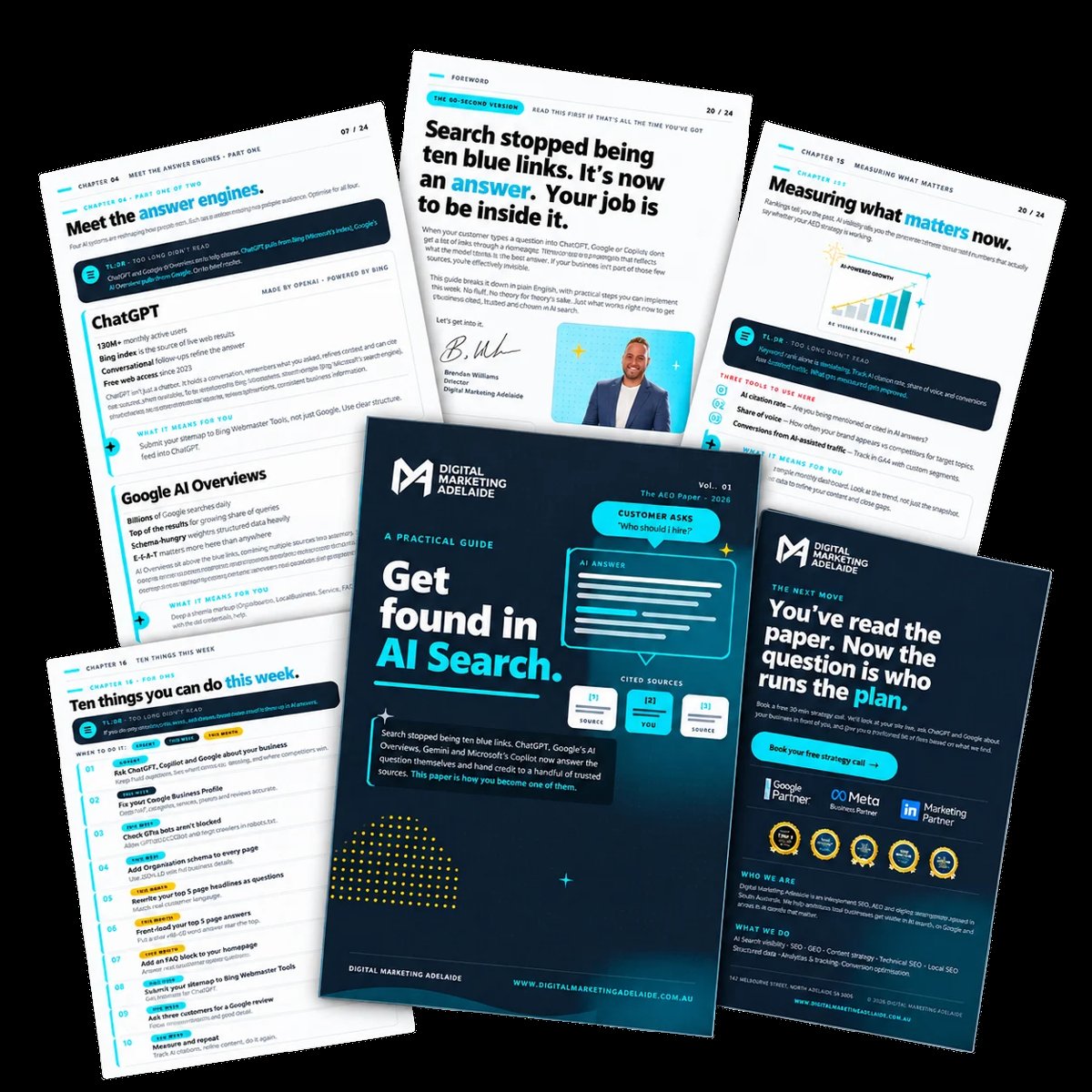
Free white paper
AI platforms like ChatGPT and Google Gemini now serve direct answers, not just links. Our free white paper explains how to get your business found in AI search, and the practical tactics behind Answer Engine Optimisation (AEO). Yours to download.
AI search doesn't come with a tidy rankings dashboard, and you should quietly ignore anyone trying to sell you an "AI position score". They made it up. What you can do is track the signals that genuinely matter.
None of these is a perfect number, because the whole point is that the old metric of a single position has gone. But tracked honestly over time, they tell you clearly whether you're becoming the answer or staying invisible.

You do not need a big project to begin, and you do not need to rebuild anything. Start with the foundations and let them compound.
Key takeaway
You do not need to chase an AI position that nobody can see. Pull the same levers trusted sources pull, consistently and honestly, and being quoted tends to look after itself.
AEO, GEO and AIO are three overlapping acronyms for roughly the same goal: making sure AI systems understand and repeat your answers. AEO means answer engine optimisation, being the source an AI picks to quote. GEO means generative engine optimisation, covering both the source and the systems that rank and cite it. AIO means AI optimisation, the broadest umbrella for every way you improve visibility inside AI-powered tools. Different writers use the terms slightly differently, but they all point at the same target: becoming a source that AI engines trust.
Yes, and it matters more than ever. The engines that generate AI answers pull almost entirely from sources that already rank well in traditional search. If a page is not ranking for a query, an AI engine has very little reason to quote it either. Ranking first is no longer the final goal on its own, but it is still the clearest proof to an AI engine that a source is credible.
It depends on where you are starting. If your site is already well structured and ranking for its core terms, you can start appearing in answers within a couple of months of focused work. If you are starting from a weaker base, give it three to six months of steady effort while your technical foundations and authority build alongside. The businesses that gain the most are the ones who start while the habit is still forming.
No. As long as your content is findable, readable and structured clearly, your existing site is fine. You do not need to rebuild it to be quoted. The important work happens in how your existing pages are written, linked and marked up, not in buying a new platform. A clean, crawlable, trustworthy site is the foundation, and that is usually a matter of fixing and improving what you already have.
About the author
Founder, Digital Marketing Adelaide
Matt Williamson is the founder of Digital Marketing Adelaide and Adelaide's face of AI Search. He leads the agency's AI search optimisation and training, and is a keynote speaker on how businesses get found in ChatGPT, Gemini and Google AI Overviews.
More about Matt SEO
SEO
 SEO
SEO
 Strategy
 SEO
SEO
 Strategy
 Local
Local
Book your free strategy call with our Adelaide digital marketing team.
Or call us on 08 8121 5844